10.
|
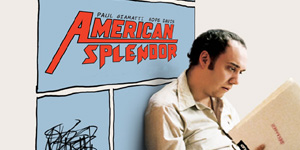 |
The story of Harvey Pekar is a
testament to the idea that there is art inside us all. Pekar's
AMERICAN SPLENDOR comics draw out the truths in the mundane aspects of
life, and the filmed version does much the same. Pekar is a quirky
personality, to be sure,
but anyone with a drive to create -- or to be liberated from the
frustrations of work and relationships -- should identify with his
life on some level. In a way, AMERICAN SPLENDOR is the most faithful
translation of comic book to film ever. The episodic nature of the
books, as well as the several different visual interpretations of Pekar
himself (owing to several
artists with their own styles illustrating the stories) are carried to
the screen intact, and somehow, these elements combine into something
thematically consistent and wholly unique. Special kudos to Paul
Giamatti's turn as Pekar -- the best role of the actor's career.
|
9.
|
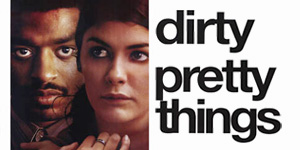 |
A uniquely British
thriller came to our shores sold only with the image of an apparently
naked Audrey Tautou (fresh in our minds from the
wonderful French import AMELIE). To add to the confusion, the film's
trailer seemed to promise something lurid and visceral. I must throw my
hands up in resignation if this is the best that can be done for a
well crafted and understated thriller that should be sold to audiences
that can think.
Sure, DIRTY PRETTY THINGS tells a story of some nasty goings-on, but
much of the film's impact comes from the idea that this sort of thing
can happen anywhere. The film is also adept at portraying a London that
is indifferent (and sometimes hostile) to the immigrants that keep
things running, a social commentary that enhances the story's thriller
aspects.
|
8.
|
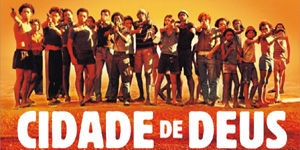 |
It's somewhat easy to heap
praise on films that can dazzle an audience with visual tricks and an
epic story, but there's something rare about one that can match style
with emotional intensity. CIDADE DE DEUS (CITY OF GOD) falls into the
latter category. The film is reminiscent of Martin Scorsese's
GOODFELLAS -- a stylized drama that follows characters from youth to
adulthood in the milieu of organized crime. Each film adeptly captures
a time and place through images and music. And although CITY OF GOD is
sometimes more brutal than Scorsese, I would argue that the Brazilian
film manages to retain more empathy for its characters by eschewing
cynicism for poignancy. (NOTE: Some critics placed this film on their
lists from 2002, but I decided to place it in 2003 because the film did
not play regular engagements outside of film festivals until 2003.)
|
7.
|
 |
Perhaps a documentary about a
rock
band with a reputation larger than their record sales is nothing
exceptionally notable, but I will go out on a limb for the makers of
GIGANTIC (A TALE OF TWO JOHNS). They Might Be Giants (John Linnell and
John Flansburgh) are a unique
institution in pop music, combining wit, humor and an artistic
sensibility in a way
that many have tried (and failed) to emulate. Director AJ Schnack has
found a way, however, to translate the unique character of the band to
a different medium. Not content to just tell the band's
story, Schnack employs bizarre asides, celebrity lyric readings and
even historical re-enactments to approximate the sprit of the Johns and
their music. I can't think of a more fitting tribute. (NOTE: Again,
this is a film that played festivals in 2002, but was finally released
in a regular theatrical run in 2003.)
|
6.
|
 |
Once upon a time, a noble
experiment called THIS IS SPINAL TAP set a standard for improvised
comedy on film. Nearly a decade later, one of that film's architects,
Christopher Guest, found new life in the format and has steadily built
a following with the faux-documentaries WAITING FOR GUFFMAN and BEST IN
SHOW. The process has come full circle with A MIGHTY WIND, wherein the
TAP trio reunite in a new guise as The Folksmen. Other familiar faces
from Guest's previous work can be found here, and it's like watching
masters at work. This team creates characters from scratch and builds
both broad comedy and compelling pathos around them. The result is the
absolute funniest film I saw in 2003 and a film with some surprisingly
touching moments.
|
5.
|
 |
They say we all can't help but
stare at the aftermath of a car wreck. The un-making of Terry Gilliam's
THE
MAN WHO KILLED DON QUIXOTE certainly qualifies -- and it's a disaster
on a scale rarely witnessed by the public. Keith Fulton and Louis Pepe
gained the trust of the visionary filmmaker
while chronicling the making of 12 MONKEYS (their excellent documentary
can be found on that film's DVD), which resulted in unprecedented
access to the QUIXOTE production. For those with an interest in how
business is run off the film set, this film offers plenty of insight.
What makes LOST IN LA MANCHA truly great, however, is the film's
ability to communicate the passion of Gilliam to the viewer, rendering
the unfolding dread all the more heartbreaking.
|
4.
|
 |
Too frequently these days, I see
films that cause my sense of whimsy to wither away. IN AMERICA renews
my faith in filmmaking with heart by addressing the issue of
maintaining your spirit in the face of adversity. The basic story
sounds positively grim -- following a tragedy, an Irish family moves to
a dilapidated apartment building in New York and befriends a dying
neighbor. But director Jim Sheridan (who co-wrote this
semi-autobiographical film with his daughters) shows skill at inspiring
awe in an audience with sequences that establish the magic of New York.
Some credit must also go to real-life sisters Emma and Sarah Bolger
(ages 7 and 11), who are possibly the most compelling children I've
ever seen on the big screen. In many ways, this is the story of the two
girls, and their innocence overshadows the occasional moments of
melodrama.
|
3.
|
 |
I was already a fan of PIECES OF
APRIL writer-director Peter Hedges but didn't know it. Hedges wrote a
personal favorite of mine, WHAT'S EATING GILBERT GRAPE, but this was
not in my mind as PIECES OF APRIL unfolded before me. What some might
consider a quirky tedious exercise in family dynamics, I found to be a
touching portrait of a family forced to cope with the fact that they
don't quite understand each other. Estranged daughter April is hosting
Thanksgiving to try and rebuild her relationship with her parents and
siblings. Her struggle toward a perfect dinner alternates with the
family's journey to the city where April lives. Hedges offsets the
heaviness of the broken family with a parade of interesting minor
characters that enrich the film's themes and add some welcome humor.
|
2.
|
 |
I consider personal ethics (or
the lack thereof) to be
one of the biggest and most interesting issues of the day. And one heck
of an
ethical dilemma is raised by Stephen Glass, a writer for The New
Republic magazine who is accused of fabricating his stories. As the
case mounts against Glass, the film's emphasis shifts to the awkward
position of New Republic editor Chuck Lane who finds his staff standing
behind Glass. On one level, this is an excellent character piece which
tries to put Glass' state of mind in perspective by his actions. As
Glass, Hayden Christensen adeptly exercises all the acting muscles that
must have been in atrophy during the production of STAR WARS EPISODE
II. I believe the most important aspect of the film, however, is the
dilemma posed -- are we too willing to sacrifice ethical standards for
what boils down to popularity and recognition?
|
1.
|
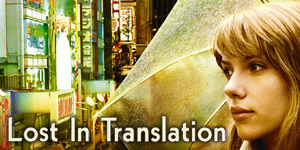 |
Occasionally, a film will
portray a simple moment shared by two people and it will communicate
something to us on the most basic, human level. LOST IN TRANSLATION has
several of those moments. Not since BEFORE SUNRISE have I enjoyed a
film so intently focused on two people and their unique bond.
Thematically, LOST IN TRANSLATION ups the ante by playing with our
notions of intimate relationships, too often portrayed in the basest
form by other films. While Bill Murray's performance here is not
exceptionally flashy, it is easily the strongest role of his career.
Murray perfectly conveys dissolution, joy and love at different points
in the film, building on what we already expect from him, but adding
fascinating new layers as well. Scarlett Johansson proves up to
the challenge of playing opposite Murray, conveying a spirit older than
the actress' 19 years would suggest. Johansson shines in wordless
moments, her expressive face carrying the emotions impressively. A
friend suggested that LOST IN TRANSLATION triggers memories in those of
us who have had fleeting but intense connections with another person. I
feel some sadness for those who don't have that sense memory to draw on
and enhance the experience.
|